The most common call we get that starts with "should I repair or just replace it?" is usually about a driveway or patio that's showing its age. Cracks, spalling, joint failure, uneven sections — they all look bad, but they don't all mean the same thing. The right answer depends on what's causing the damage, how widespread it is, and what the concrete is sitting on.
When Patching and Repair Makes Sense
Concrete repair is the right call when the damage is isolated and the underlying cause is manageable. Specifically:
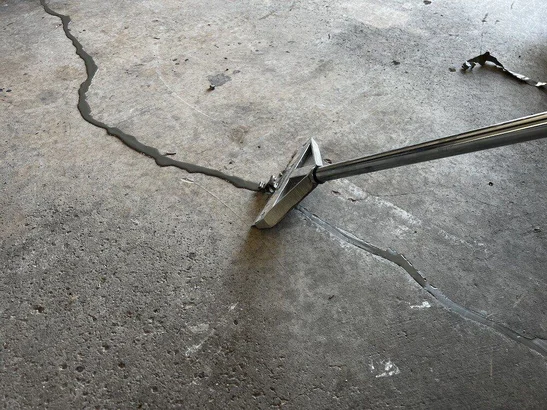
- Hairline and narrow cracks that haven't widened or shifted over time — these are typically caused by normal concrete shrinkage and can be filled with a polyurethane or epoxy crack filler
- Joint failure where the flexible sealant between slabs has dried out and pulled away — resealing control joints is a straightforward maintenance task that prevents water infiltration and freeze-thaw damage
- Surface spalling confined to a small area — shallow surface delamination caused by de-icing salt damage or poor finishing can sometimes be addressed with a bonded overlay rather than full removal
- A single isolated section that has settled or cracked while the rest of the slab is solid — targeted saw-cutting, removal, and replacement of just that panel is cost-effective if the surrounding concrete is in good shape
When Replacement Is the Better Investment
Repair becomes a bad investment when the root cause can't be fixed or when the damage is too extensive for patches to hold. Replace when you see:
- Widespread cracking across more than 25–30% of the surface — at that point you're patching more than you're preserving, and the patches will show
- Vertical displacement at cracks — when one side of a crack is higher than the other, it signals differential settlement in the sub-base. Patching the crack doesn't fix the soil problem beneath it
- Active heaving from tree roots — if roots are pushing the slab upward, they'll continue to do so after any repair
- Aggregate exposure and deep scaling across large areas — this level of surface deterioration typically means the mix quality or installation was poor from the start, and the whole slab will continue to break down
- Concrete 30+ years old with multiple issues — older concrete that's been repaired several times is often past the point where additional repair is cost-effective
The Sub-Base Problem
This is the factor that most homeowners don't think about: the condition of the material under the concrete. In Western Arkansas, expansive clay soils shift seasonally as they absorb and release moisture. If the sub-base under a slab has deteriorated or was never adequate to begin with, any repair you put on top will fail at the same rate as the original surface.
A good concrete contractor will look at the edges of any damaged area and assess the sub-base before recommending repair vs. replacement. If you're seeing your third or fourth round of cracks forming in the same spots, that's the sub-base telling you something.
The Cost Comparison
Concrete repair in Western Arkansas typically runs $4–$10 per square foot for crack injection and localized patching. Full replacement runs $7–$14 per square foot depending on thickness and access. Repair wins financially when it's genuinely durable — but a $1,500 repair that fails in two years is far more expensive than a $6,000 replacement that lasts 30.
If you're not sure which way to go, we're happy to come out and take a look. Our estimates are free and written — call or text (479) 551-1642.